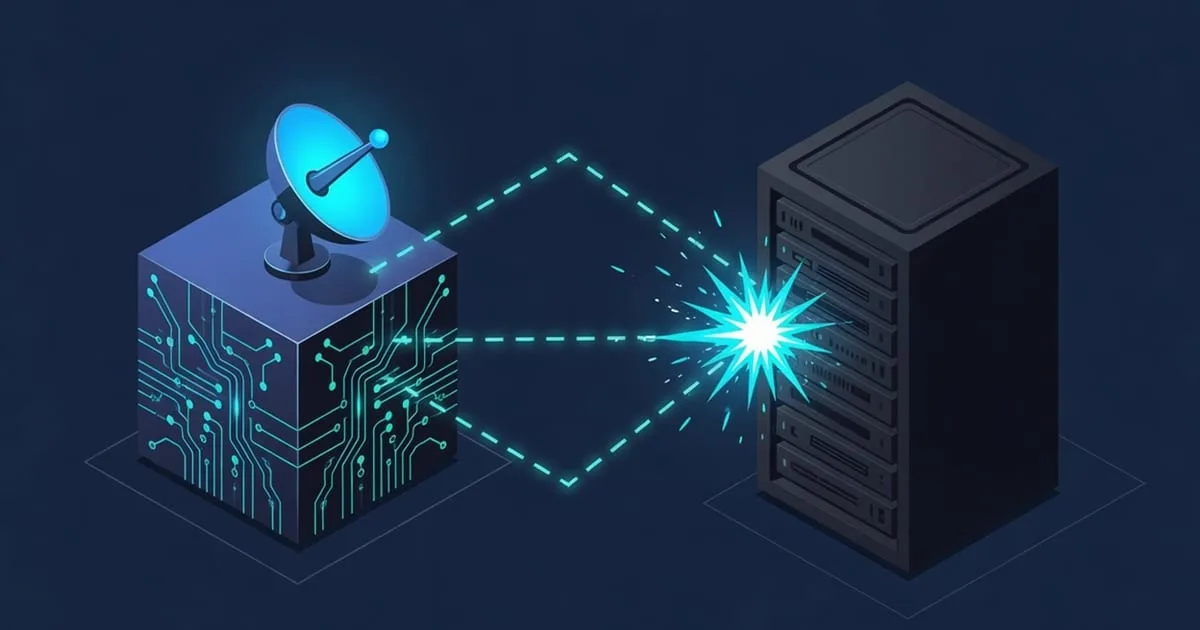
Agentless External Monitoring
Agentless monitoring means you watch a server's health without installing yet another piece of software on it. No custom daemon, no vendor sidecar eating memory, no fleet of agents to patch every quarter. Instead you read what the machine already publishes — most often over SNMP — and you do the reading from somewhere else entirely. That "somewhere else" is the part that matters, and it's the part this page is about: polling a box from outside its own network so you still learn something useful when the box itself is in trouble.
What is Agentless External Monitoring
Agentless monitoring is a collection model. Rather than deploying a proprietary collector onto every host, you query interfaces the operating system exposes natively — SNMP, WMI, SSH, an HTTP endpoint — and gather metrics remotely. In the SNMP world the server runs a small, standard daemon (snmpd) that ships with the OS. That's the nuance people argue about: agentless SNMP still involves a lightweight agent on the wire, but it's the standard SNMP service defined by the RFCs, not a bespoke monitoring binary you have to trust, update, and secure yourself.
Why does the distinction matter? Because every agent you install is code that can crash, leak memory, conflict with a library, or become a supply-chain worry. Agentless collection sidesteps most of that. And when the collector runs externally — off the monitored host, ideally off its whole network — you gain something an on-box tool can never give you: an independent vantage point that survives the very failures you most want to catch.
It helps to separate two ideas that often get bundled together. "Agentless" is about what runs on the host — ideally nothing beyond standard services. "External" is about where the collector sits — off the box entirely. You can be agentless without being external (a local script scraping SNMP), and you can run an agent externally too. The combination this page argues for is both at once: no proprietary software on the server, and the watching done from somewhere the server's problems can't reach.

How it works in practice
The mechanics are refreshingly plain. A poller on the outside sends SNMP requests to the target's agent over UDP 161, the agent answers with the current value of whatever OID you asked for, and the poller records it. Repeat on a schedule and you have a time series. No push, no open outbound connection from the server, no software rollout.
Here's the typical flow when you set up agentless SNMP against a Linux host:
- Enable
snmpdon the server and expose a read-only SNMPv2c community (see the snmpd.conf guide for the exact config). - Allowlist only the OIDs you intend to read, so the community can't walk the entire tree — the OID allowlist page shows the
viewlines. - From the monitoring side, confirm the values return with a single command.
- Point your external poller at the same OIDs on a fixed cadence and store the history.
A quick reachability test from the collector looks like this:
snmpwalk -v2c -c public 203.0.113.10 1.3.6.1.2.1.25.1.1.0
That reads hrSystemUptime from the Host Resources MIB (RFC 2790). Swap the OID for CPU, memory, or interface counters and the pattern is identical. The server never dials out; it just answers questions when asked.
| Aspect | External agentless (SNMP) | Internal agent |
|---|---|---|
| Software on host | Standard snmpd only | Proprietary collector to install/patch |
| Vantage point | Outside the network | On the failing machine |
| Survives host crash | Yes — poller is independent | No — dies with the host |
| Protocol | SNMP over UDP 161 | Vendor-specific, usually outbound |
| Resource cost on host | Minimal | Ongoing CPU/RAM |
Benefits
- Nothing extra to deploy. You lean on
snmpd, a service the OS already provides, instead of rolling a monitoring agent across hundreds of hosts. - Smaller attack surface. Fewer moving parts means fewer things to exploit or keep updated. A read-only, allowlisted SNMPv2c community is easy to reason about.
- Vendor-neutral data. SNMP OIDs are standardized in public RFCs, so the same query works across Linux, routers, switches, and printers.
- Low overhead on the host. Answering an SNMP poll costs almost nothing; the work of graphing and alerting happens on the collector.
- Independent failure domain. Because the collector lives elsewhere, a host that has fallen over can't take its own monitoring down with it.
- Consistent tooling. One poller, one protocol, and the whole estate looks the same — no per-app plugin zoo.
The external / independent angle
Now the important part. An agent that runs on the server you're watching shares that server's fate. If the machine is pinned, swapping to death, or fully crashed, the on-box notifier is the one thing least able to send its warning — it needs CPU, memory, and a working network stack, which are exactly the resources that just vanished. You get silence right when you most need noise.
External collection breaks that dependency. This is the whole logic behind double durability: it's better to be told by two independent sources than to be told by none. An outside poller keeps asking the SNMP agent for readings on its own hardware, on its own schedule, using its own network path. When the host goes quiet, the absence of an answer is itself a signal — the poller notices the timeout and raises an alert. A local agent can't report "I'm down," because down means it can't report anything.
There's a second, quieter benefit to watching from outside: you see the server the way the rest of the internet does. Latency, packet loss, a firewall rule that broke after a change — an external checker catches problems that live in the path between users and the machine, not just on the machine itself. That perspective is impossible to get from a process running behind the same NIC it's supposed to be judging.
None of this means you throw away on-box tooling. Deep application traces, log tailing, per-request profiling — those genuinely need to live on the host, and they're valuable. The point is narrower: for the specific job of knowing the server is in trouble, an agent that shares the server's fate is the wrong tool, and an independent agentless poller is the right one. Use each where it's strong.
When to use it
Reach for agentless external monitoring when the independence is worth more than deep, app-level introspection. It fits a lot of situations:
- Fleets where installing and maintaining agents everywhere is a chore you'd rather skip.
- Network gear — routers, switches, firewalls, printers — that only speaks SNMP and won't accept an agent at all.
- Any host where you specifically need outage detection that survives the outage, layered on top of whatever internal tooling you already run.
Pair it with sensible timing from the check frequency guide, route the results to email and SMS alerts, and understand where it differs from uptime checks by reading HTTP vs SNMP monitoring. For a full picture of what the standard daemon can report, server health monitoring covers the metric families. In practice, ostr.io Monitoring implements exactly this model — a zero-setup SaaS that polls your SNMPv2c endpoints from outside your network and alerts by email and SMS.