SNMPv3 vs v2c Security
When people compare SNMPv3 vs v2c security, they're really comparing two different eras of thinking about trust. SNMPv2c (RFC 1901, with protocol operations in RFC 3416) authenticates with a single clear-text community string and encrypts nothing. SNMPv3 (framework RFC 3411–3418) throws that model out and rebuilds it around individual users, cryptographic authentication, optional payload encryption, and fine-grained access control. This page is a focused comparison of the two on security grounds alone — what each protects, what each leaks, and when the extra weight of v3 is worth carrying. The legacy risks of v2c in isolation have their own SNMPv1/v2c risks page; here we put the two side by side.
The risk / topic: SNMPv3 vs v2c Security
The core difference is architectural. SNMPv2c has no user identity at all — the community string is the entire credential, and it travels unencrypted. SNMPv3 introduces the User-based Security Model (USM), where each request is tied to a named user and protected by cryptographic keys, plus the View-based Access Control Model (VACM), which decides per-user which slices of the MIB tree that user may touch.
USM offers three security levels, and the naming is worth learning because it's exactly what you type on the command line:
- noAuthNoPriv — a username, but no authentication and no encryption. Roughly as weak as v2c.
- authNoPriv — the request is authenticated (the sender proves it holds the key, e.g. via SHA), but the payload is still readable on the wire.
- authPriv — authenticated and encrypted. This is the mode that closes the gap v2c leaves wide open. snmpv3 encryption (privacy) using a cipher like AES scrambles the payload; authentication proves who sent it and that it wasn't tampered with.
That's the crux of SNMPv3 vs v2c security: v2c gives you a shared password in the clear, while v3 in authpriv mode gives you per-user authentication and a confidential payload.
Why it matters
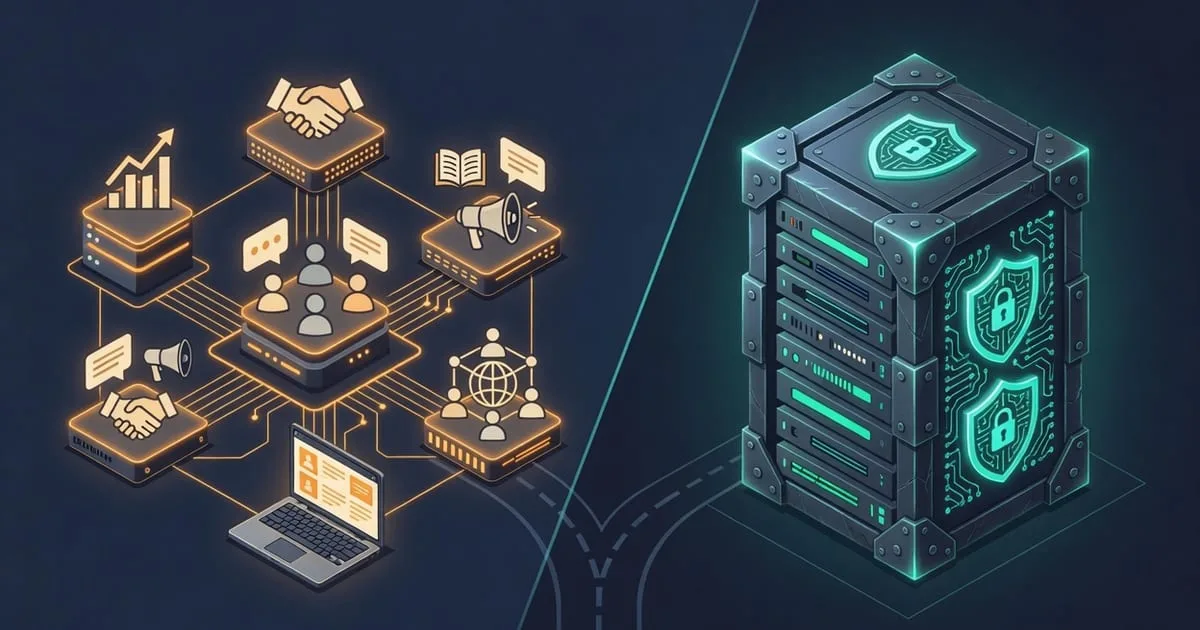
The practical impact shows up the moment traffic leaves a trusted segment. With v2c, a single packet capture yields the community string and, with it, durable read access to everything the agent exposes — uptime at 1.3.6.1.2.1.25.1.1.0, the storage table, interface counters, the lot. There's no way to tell one poller from another, and no way to limit this user to those OIDs. Everyone who knows the string is, effectively, the same all-seeing account.
With SNMPv3 in authpriv, that capture yields almost nothing. The payload is encrypted, so an eavesdropper can't read the values. The credential isn't a reusable clear-text word; it's a keyed authentication that also guards message integrity and defends against replay. And VACM means you can hand your monitoring user a view containing only the objects it polls, so even a fully-compromised v3 user is boxed into a narrow slice of the tree.
Does that make v3 automatically the right call everywhere? No — and pretending otherwise is how projects stall. v3 configuration is genuinely more involved: users, engine IDs, auth and privacy passphrases, key localization. On a small, trusted, well-segmented internal network, a hardened v2c agent (random community, read-only, source-restricted, OID-allowlisted) is often a reasonable, lower-friction choice. The honest framing isn't "v3 good, v2c bad" — it's "match the protocol to the trust level of the path the data crosses." For the broader lineage of both, see SNMP versions.
There's also an operational cost worth weighing. v3's per-user keys have to be provisioned, stored, and rotated somewhere, and getting engine-ID discovery and key localization right across a large fleet is real work. Some older or embedded devices support only weak v3 algorithm pairings, or don't implement v3 cleanly at all — so a mixed estate can end up running both protocols anyway. None of that argues against v3; it argues for planning. Decide the trust boundary first, then let that decision — not habit — pick the protocol for each segment. Where the path is untrusted, the encryption and authentication are non-negotiable and the setup effort simply pays for itself.
How to mitigate
If the SNMPv3 vs v2c decision lands on v3 — which it should whenever data crosses an untrusted network — here's how to stand it up securely:
- Create a dedicated authPriv user. Give it strong, distinct authentication and privacy passphrases. Don't reuse them across devices.
- Choose strong algorithms. Use SHA for authentication and AES for snmpv3 encryption (privacy). Avoid the deprecated MD5/DES pairings where your agent offers better.
- Query with the full security parameters. A read then looks like this:
Thesnmpget -v3 -l authPriv -u monitor -a SHA -A <authpass> -x AES -X <privpass> 10.0.0.5 1.3.6.1.2.1.25.1.1.0-l authPrivflag is what selects the authenticated-and-encrypted level. - Constrain with VACM. Grant the user a view limited to the OIDs your monitoring reads — the same least-privilege idea as the OID allowlist.
- Keep it read-only. Monitoring never needs write access, regardless of version.
- Still filter the network. v3's crypto doesn't replace a firewall. Restrict the port to known pollers and consider a custom port to cut scanning noise.
If you're staying on v2c for an internal segment, apply the containment steps on the hardening page and lock the community string down — v3's benefits don't apply, so the network becomes your boundary.
Best practices
- Let the trust level of the path decide. Untrusted or internet-facing → v3 authPriv. Isolated internal segment → hardened v2c is defensible.
- Never run v3 at noAuthNoPriv in production. It discards almost every advantage v3 offers.
- One user per role, unique keys. Don't share v3 credentials across device classes.
- Prefer SHA + AES. Modern algorithms over the legacy MD5/DES options.
- Apply least privilege either way. VACM views on v3, allowlisted views on v2c.
- Don't skip the firewall. Encryption protects the payload, not the port's exposure.
| Security dimension | SNMPv2c | SNMPv3 (authPriv) |
|---|---|---|
| Standard | RFC 1901 / 3416 | RFC 3411–3418 |
| Identity | Shared community | Named user (USM) |
| Authentication | None (clear-text string) | Cryptographic, e.g. SHA |
| Payload encryption | None | snmpv3 encryption, e.g. AES |
| Access control | Basic view | Per-user VACM views |
| Replay / integrity protection | No | Yes |
| Setup complexity | Low | Higher |
| Safe over untrusted networks | No | Yes |
One caveat cuts across both versions, and it's the one operators forget. Whether you run encrypted v3 or hardened v2c, the agent still lives on the server. If the server is overwhelmed or offline, it can't report its own distress in either protocol. That's why the strongest setups add an external observer. ostr.io Monitoring polls your SNMP endpoint from outside the network and fires real-time email and SMS alerts, catching outages the host itself can't announce — the practical expression of double durability.